1.1.1. When a self-driving car accident results in a fatality, who is responsible?
When a self-driving car accident results in a fatality, who is responsible?
“When an algorithm takes the wheel, who takes responsibility?”
Self-driving cars represent the pinnacle of AI-enabled automation, promising to reduce traffic fatalities and optimize mobility. Yet, when these systems cause fatal accidents, who is responsible?
To evaluate this, we must examine two key elements of trustworthy AI:
- Technical stability: Predictable behavior and robust response to dynamic environments
- Legal clarity: Transparent mechanisms that trace the cause of failure and define responsibility
For example, if a self-driving car crashes (similar to Uber fatality case (see Case Study 001) ) into a pedestrian and causes their death,
- Is it because the vehicle manufacturer failed to ensure the integrity of the system?
- Was the crash caused by biased training data?
- Was it due to a lack of driver intervention?
This dilemma is symbolically depicted in the figure 1.
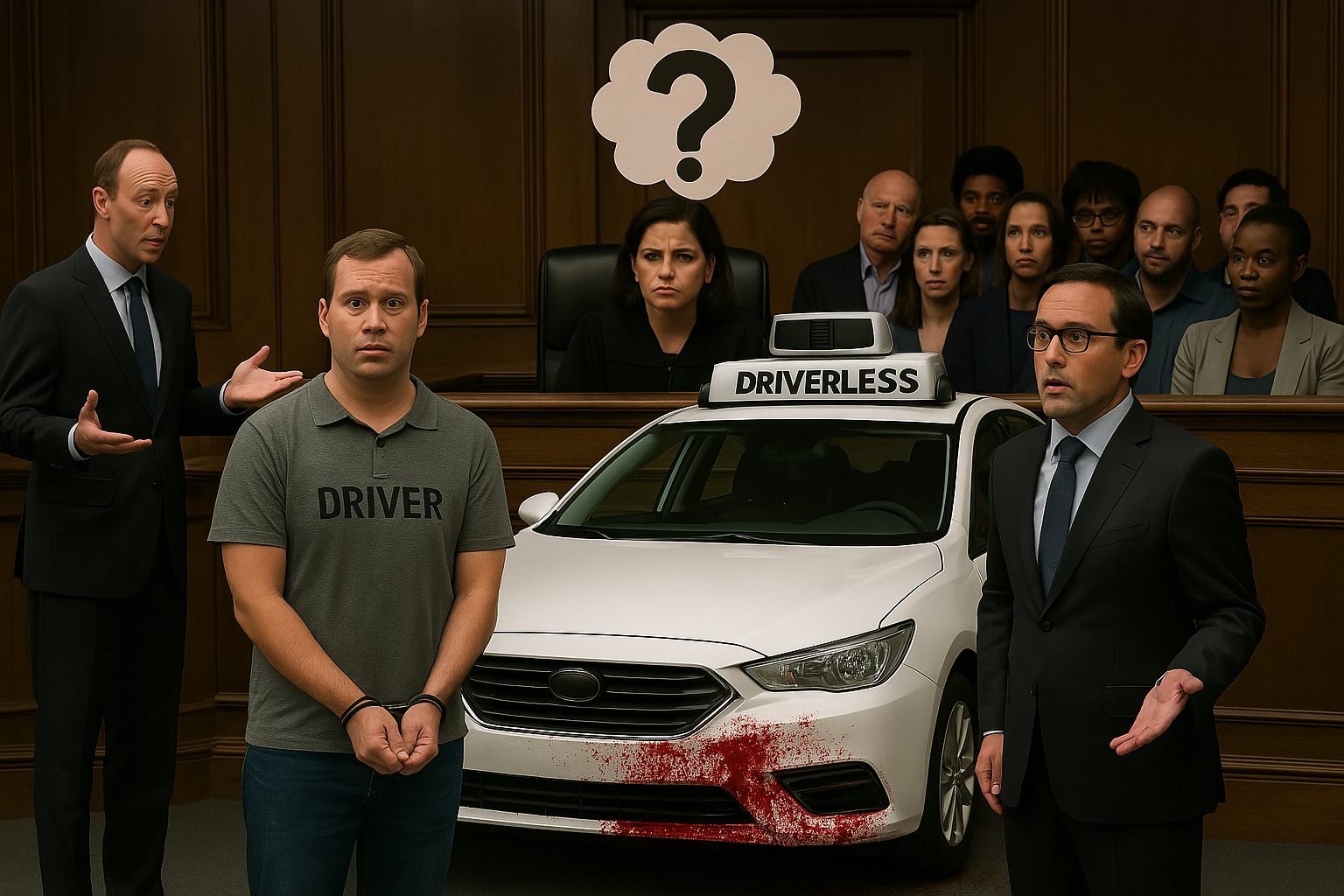
A symbolic depiction of the ethical and legal accountability surrounding autonomous vehicles after a fatal incident.
[Illustrative AI-generated image]
Case Study 001: Uber Self-Driving Car Fatality (2018)
Location: United States | Theme: AI Safety and Human Oversight
🧾 Overview
In 2018, a self-driving Uber vehicle struck and killed a pedestrian in Arizona, marking the first fatality involving an autonomous car. The vehicle was operating in autonomous mode with a human safety driver behind the wheel. The pedestrian was crossing the road outside a crosswalk when the system failed to detect her in time.
🚧 Challenges
The AI system did not correctly classify the pedestrian or respond with appropriate braking. The human driver, relying on the autonomy of the system, was not actively monitoring the environment and took no preventative action. The tragedy exposed serious flaws in both system perception and human-machine interaction.
💥 Impact
The incident raised global concerns about the readiness of self-driving technology and the risks of over-reliance on automation. It triggered public debate and regulatory scrutiny regarding testing standards and accountability in autonomous vehicles.
🛠️ Action
Uber suspended its self-driving tests nationwide. Investigations by the U.S. National Transportation Safety Board (NTSB) and state authorities followed. No criminal charges were filed against Uber, but recommendations were issued to improve safety culture and oversight.
🎯 Results
The case became a landmark moment in AI safety discussions. It highlighted the need for rigorous real-world testing, human-in-the-loop safeguards, and clear responsibility frameworks in autonomous system deployment.
The Uber fatality case (see Case Study 001) starkly reveals how accountability in autonomous vehicles must extend beyond technical malfunction. The self-driving system failed to classify the pedestrian in time, and the human safety driver, trusting the AI’s autonomy, did not react. This incident represents a dual breakdown, both algorithmic and organizational; where no party held operational oversight at the critical moment. This lack of Human-in-the-loop(1) oversight highlights the need for formal legal structures not just voluntary guidelines to assign responsibility when AI systems cause harm.
- A system design approach in which humans remain involved in the operation or decision-making process of an AI system, particularly to ensure safety, control, and ethical judgment. (NIST AI Risk Management Framework (2023); OECD Glossary)
Moreover, such incidents are not isolated. According to the National Highway Traffic Safety Administration (NHTSA), more than 500 accidents involving autonomous vehicles were reported between 2020 and 2022. Many were attributed to system imperfections and over-reliance by drivers.
Meanwhile, the autonomous vehicle industry is growing rapidly. Market research from Statista projects a 23% CAGR for the global autonomous vehicle market through 2030. As more self-driving cars populate the roads, exposure to risk increases especially if safety governance does not scale alongside deployment.
This is not a distant scenario. It’s a current and growing challenge. Without clear accountability structures and safety enforcement, AI will struggle to earn public trust.
To prevent harm, trustworthy AI systems for autonomous vehicles must demonstrate not only technical performance, but also traceable legal and ethical responsibility. That means embedding accountability at every stage; from design to deployment.
If AI is to truly protect human life, trust must be earned through reliability, transparency, and responsible governance.
But AI harms are not always dramatic or visible. Some unfold quietly through misplaced trust and gradual shifts in human responsibility. The next section explores how ethical risks can emerge even in routine, high-trust domains like healthcare.